
Apostille for documents used in the Philippines
If you have been told to get a document "red ribboned" at the Philippine consulate, that advice is out of date by years. Since 15 May 2019, Philippine consulates in the United States no longer authenticate American public documents. The Philippines joined the Hague Apostille Convention, and consular authentication was replaced by the apostille.
The change is stated plainly on the consulates' own websites, and it is still the single most persistent piece of misinformation in Philippine paperwork. If a website still tells you to have a US document authenticated at the consulate, it was written before May 2019 .
What the consulate can no longer do
A Philippine consulate in America cannot authenticate the signature on:
- Any document notarised by a US notary public.
- Any document signed, issued or certified by a federal, state, county, city, university or school official: birth and marriage certificates issued by a US state, court orders, diplomas, transcripts, police records, corporate filings.
To use any of those in the Philippines, you need an apostille certificate issued by the competent US authority, and nothing else. The consulate is not part of the chain.
Where the apostille actually comes from
It depends on who issued the document:
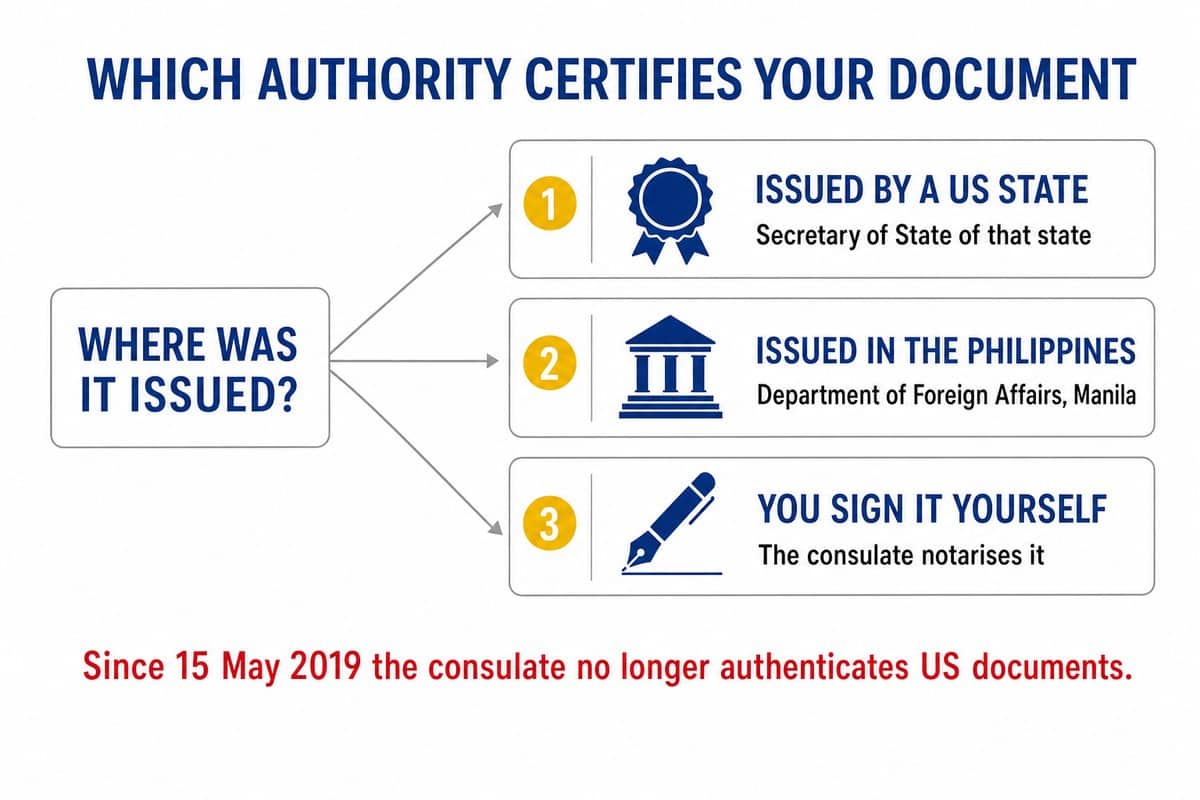
- State documents (birth certificates, marriage certificates, notarised affidavits, court records, school transcripts) are apostilled by the Secretary of State of the state that issued them. Not the state you live in now: the state the document came from.
- Federal documents (FBI identity history summaries, federal court records, documents signed by a federal agency) go to the US Department of State Office of Authentications in Washington.
Most states accept applications by post and many now handle them online. The Philippine consulates themselves point applicants to their state's apostille page: Los Angeles, for example, lists the offices for California, Arizona and Nevada, the three jurisdictions it covers.
For a document that first has to be notarised (an affidavit, a deed, a consent letter) the sequence is notarise, then apostille. The apostille certifies the notary’s commission, so it cannot be issued before the notarisation exists.
And it must be the same state throughout: a document notarised in Nevada is apostilled by Nevada, even if you live in California.
Going the other way: Philippine documents used in America
The convention works in both directions. A document issued in the Philippines: a PSA birth certificate, a CENOMAR, an NBI clearance, a Philippine court order, is apostilled by the Philippine Department of Foreign Affairs, in the Philippines.
That is not something a consulate in the United States can do for you either. If you need a Philippine document apostilled, the step happens in Manila, usually through a relative or a representative acting on your behalf, which is one of the commonest reasons people execute a special power of attorney.
So what is left for the consulate?
A great deal, but it is a different act. Consular officers still perform notarisation: they witness you signing a document that will be used in the Philippines, and they seal it. That is not authentication of somebody else's signature. It is the original notarial act, done by a Philippine official.
The practical distinction:
| Your document | Who certifies it | Where |
|---|---|---|
| A power of attorney you have not signed yet | Consular notarisation, no apostille needed | Your consulate |
| Anything a US notary already notarised | Apostille, the consulate cannot touch it | Secretary of State |
| A US birth or marriage certificate | Apostille | Secretary of State of the issuing state |
| A federal document, FBI summary or federal court order | Apostille | US Department of State |
| A Philippine PSA document, CENOMAR or NBI clearance | Apostille | Department of Foreign Affairs, Manila |
Choosing between the first two routes is worth a moment's thought. Signing at the consulate means an appointment and a trip, but produces a finished document. Using a local notary is quicker, but adds an apostille step and a fee at the Secretary of State.
What to ask before you spend anything
- What exactly does the requester need? An apostille, a consular notarisation or a certified copy. Ask in writing.
- Who issued the document? An American authority means no consulate can help with the authentication; a Philippine one means Manila.
- Which state issued it? The apostille comes from that state, not the one you live in.
Philippine banks, registries, schools and courts vary in what they accept, and a document prepared for the wrong route usually has to be redone from the start.
Then check what your document is. If it was issued by an American authority, no Philippine consulate in the United States can help you with the authentication, and every hour spent trying to book that appointment is an hour not spent with your state's Secretary of State. Find your consulate in the consulate directory for the things it genuinely can do.