
PSA birth certificate and CENOMAR from the United States
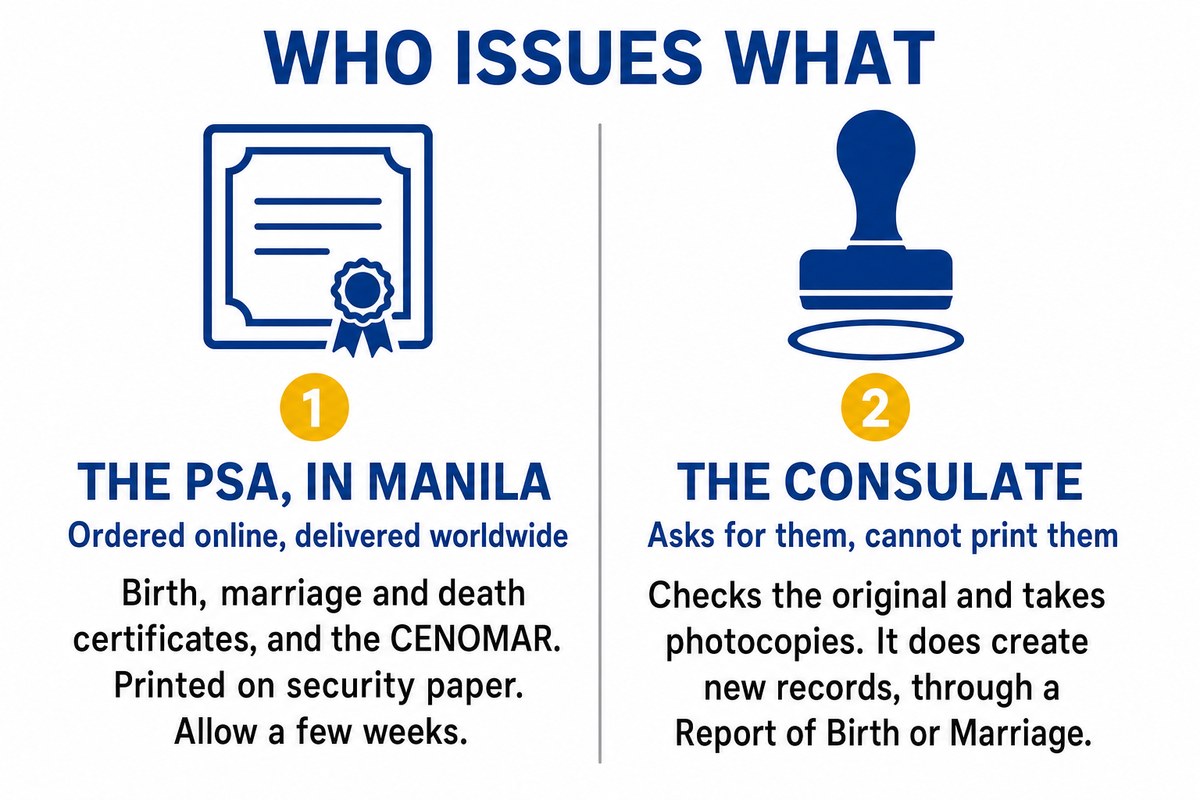
This is the most searched Philippine document in the United States, and it is the one the consulate does not issue. Birth certificates, marriage certificates, death certificates and the CENOMAR all come from the Philippine Statistics Authority in Manila. A consular officer will ask you for one, check it and photocopy it, but nobody at a Philippine consulate in America can print you a new one.
Knowing that saves the single most common wasted trip in this whole system. If what you need is a PSA certificate, you do not need an appointment, a drive to Los Angeles or a morning off work. You need a web form and about two weeks.
What a PSA certificate actually is
The Philippine Statistics Authority holds the national civil register. When a birth, marriage or death is recorded anywhere in the Philippines, or reported from abroad through a consulate, the record ends up with the PSA, and the PSA is the only body that can issue a certified copy of it.
The copy that counts is printed on SECPA security paper, the pale document with the security features and the PSA seal. This matters more than people expect:
- A certificate from your local civil registrar in the province is not a PSA copy, however official it looks. Consulates ask specifically for the PSA version.
- A photocopy, a scan or a printout of a PDF is not a PSA copy either. The security paper is the point.
- Most consulates want the original plus photocopies, often four sets, because a Report of Birth is filed in quadruplicate.
The four documents people actually order
Open the one you need:
How to order one from the United States
There are two official online channels, both run for the PSA:
- PSA Helpline, psahelpline.ph
- PSA Serbilis, psaserbilis.com.ph
Both deliver internationally. You fill in the details of the record, pay by card, and the certificate is couriered to your American address. Delivery abroad is the slow part: allow a few weeks rather than a few days, and order well before you need it.
Every consulate says the same thing in different words: turning up without the PSA copy means being turned away. The Los Angeles dual citizenship page puts it plainly, get the documents first, book second. Since delivery to the United States takes weeks and appointment slots at some consulates open only once a week, doing it the other way round is how people lose their slot.
When the details do not match
This is where PSA certificates cause real trouble. The name on your PSA birth certificate is the name the Philippine government considers yours. If your US passport, your naturalisation certificate or your driving licence says something different (a married surname, an anglicised spelling, a middle initial that became a full name) the mismatch has to be explained before anything can proceed.
The fix is an Affidavit of One and the Same Person, notarised, plus documentary proof of how the second name came about: a marriage certificate, a court order, a change of name recorded in the naturalisation certificate.
And note the hard rule on passports: the name on your Philippine passport follows the PSA document. A consulate cannot use a non-PSA document as the basis for changing a name. If the PSA record itself is wrong, that is corrected in the Philippines, not at a counter in America.
What the consulate does and does not do
- It does not issue PSA certificates, reprint them, certify them or speed them up.
- It does require them, in original, for passports, dual citizenship, civil registry filings and most notarial work.
- It does create new PSA records indirectly: a Report of Birth or Report of Marriage filed at a consulate is transmitted to the Philippines and eventually becomes a PSA-issuable record.
That last point is worth holding on to. If your child was born in the United States and you have never reported the birth, there is no PSA record to order. You have to create it first. Ordering a certificate that does not exist yet is a common and frustrating dead end.
Before you order
- Every name, spelled out. Including middle names and the mother’s maiden surname.
- The exact date of the birth, marriage or death.
- The place of registration, which is the town that recorded it, not necessarily where it happened.
Then, once the certificate is in your hands, look at what you are actually going to use it for. Several of the things people assume need a consulate do not: an apostille on an American document comes from your state, and an NBI clearance is applied for by mail to the Philippines. Find your consulate on the directory of Philippine consulates only for the steps that genuinely need a consular officer.